Transcontinental Journeys: How Irises Traversed Across Antarctica
Exploring Antarctica as a corridor for the iris family to spread. Written by guest blogger Zainab Vawda.
Published on 23rd November 2026
Iridaceae is the plant family best known for producing vibrant bearded irises and cheerful springtime crocuses. But what if this eye-catching family also held clues to the mystery of how Southern Hemisphere plant families dispersed across vast continental distances millions of years ago? A recent paper by Newmarch et al., published in the Botanical Journal of the Linnean Society, investigates how the ancestors of two genera in Iridaceae may have used Antarctica as a corridor to establish a unique geographical distribution that we see today.
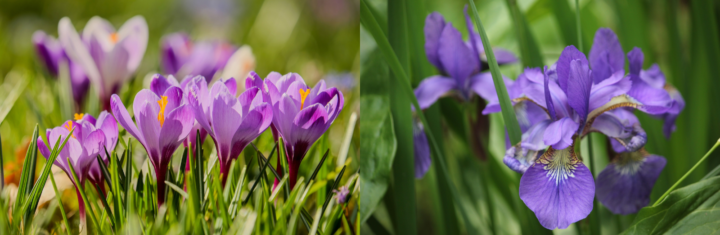
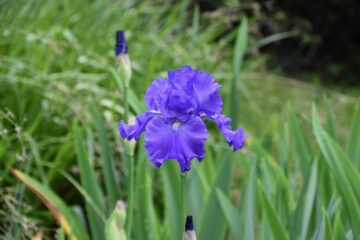
Cheerful spring blooms like those of crocuses and irises shown above are known to carpet British countrysides.
Setting the Scene
The Iridaceae family encompasses 2030 extant species found on every continent except Antarctica. Yet, most clades within the family likely originated in Australasia, so how did some members end up 15,000km of ocean away, in South America?
The Out-of-Australasia hypothesis offers some interesting insight into how plant families may have travelled such vast distances. According to the hypothesis, some plant lineages originated in Australasia millions of years ago, when it was still interconnected to other landmasses such as Antarctica. These plant lineages then spread across the interconnected landmasses and diversified into more lineages as landmasses began to disconnect. It's plausible that plants even spread across Antarctica, because c. 14-15 million years ago (MYA) Antarctica was not quite the expanse of ice that we know it to be today. Instead, it likely had a temperate or even tropical climate since there’s fossil evidence of vegetation. As Antarctica was also once connected to both Australasia and South America, it had major potential for shaping Southern Hemisphere flora by acting as a corridor for plant movement.
Libertia and Orthrosanthus are two closely related genera in the Iridaceae family. They are both unique because their ancestor appears to have originated near South America, which begs the question: how are these genera now widespread across Australasia (Figure 1)? It was these genera that became the focus of this study, aiming to investigate the broader question of how Antarctica contributed to shaping the modern distribution of Iridaceae.
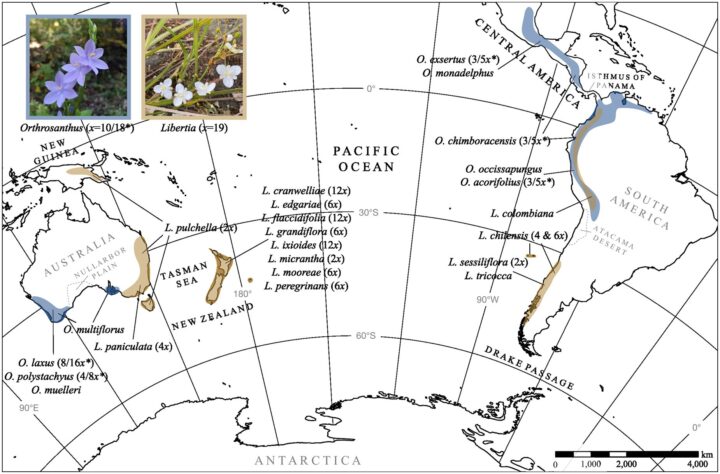
Figure 1: A map showing the modern-day distributions of Orthrosanthus (blue) and Libertia (beige) in both South America and Australia (and New Zealand for Libertia). Taken from Newmarch et al., 2026.
Uncovering History
To understand the geographical movement which occurred in Iridaceae's past, scientists used ancestral range estimation analyses to predict where Libertia’s and Othrosanthus’s ancestors may have lived. They created a model which tested different scenarios by which their ancestors may have spread across different regions and then used a scoring system to identify which possibility was most likely to occur. For example, high scores were given to connected landmasses due to a higher likelihood of movement between them. Conversely, low scores were given to distant landmasses separated by expanses of open ocean because of the lower (but not impossible!) chance of dispersal. Importantly, and unlike previous studies, this model included Antarctica when creating different scenarios of movement, which allowed researchers to see if it did play the role of a ‘corridor’ in Iridaceae’s past.
A Long and Arduous Journey
When the researchers pieced together evidence from the ancestral range estimations, DNA analyses, phylogenetic trees (which are like family trees), and the timings of key geological events, a hypothesis for the irises' journey to South America and Australasia emerged.
Libertia and Orthrosanthus are both part of a tribe called Sisyrincheae. The most recent common ancestor (MRCA) of Sisyrincheae probably originated roughly in the region of South America and Antarctica, when they were both connected. Then, the Drake’s passage opened c. 50-30 MYA, splitting apart not only South America and Antarctica, but also Sisyrincheae’s ancestral population. Known as ‘vicariance’, the physical splitting of the population created limited gene flow between them, allowing genetic differentiation and specialistion to accumulate over time.
The population left behind in Antarctica is thought to contain the ancestors of the Libertia-Othrosanthus lineage. These ancestors then appeared to traverse across Antarctica (remember, it’s still habitable and green at this point!) to make its way back to Australasia. Yet, it was in the Early Miocene (c. 20 MYA) in Australasia where the two genera truly diverged, due to environmental changes such as forest shrinkage and grassland expansion.
From here, the authors proposed some long-distance and transoceanic dispersal events leading to the distributions across New Zealand, Northern and Western Australia that we see today. Trans-oceanic dispersal also became more plausible because ocean currents were strengthening and could facilitate dispersal better.
Lessons Learnt
This study has expanded our insight into the complex long-term and long-distance processes which have not only shaped the flora of Iridaceae, but also the flora of the Southern Hemisphere. It also contributes to solidifying Antarctica’s integral role as a former corridor, allowing plant families to spread far and wide.
Guest Blogger
This blog was written by guest blogger Zainab Vawda, a recent graduate of BSc Biological Sciences from Imperial College London. She is interested in botanical illustration, animal behavioural ecology, and especially science writing, as it means more people can appreciate the wonders of biology!
About the Journal
This blog was inspired by a paper published in our Botanical Journal, an international journal publishing high-quality original papers relating to the biology of both plants and fungi. Want to contribute to a blog? Contact the Journal directly.