Bats Out of the Caribbean: What Decides When They're Gone, Gone, Gone?
Caribbean bats prone to extinction are, paradoxically, medium-sized and live on larger, flatter islands. Written by guest blogger Lucy Jackson.
Published on 9th November 2026
Caribbean bats [Fig.1] are highly adapted but are vulnerable to environmental change. A new study, published in the Evolutionary Journal of the Linnean Society, discovered which factors drive bats to extinction.
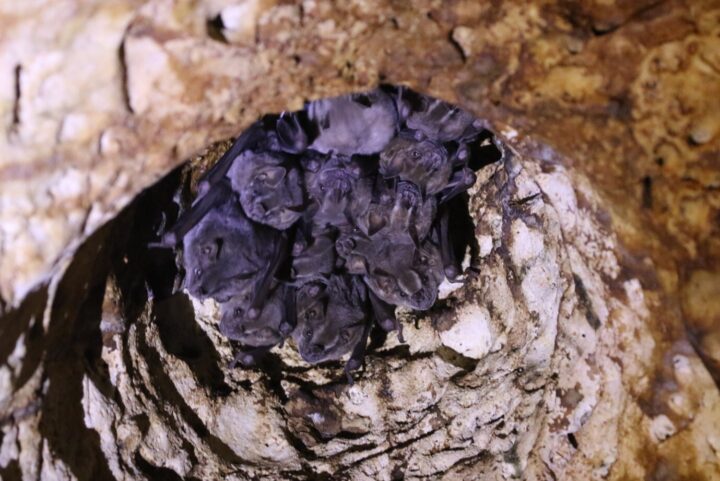
Figure 1: Jamaican Fruit-eating Bat (Artibeus jamaicensis), photographed in Jamaica. Photo Credit: Henggang Cui under Public Domain Dedication: https://www.inaturalist.org/photos/338916880
Globally, there are more than 1500 species of bat, making up around 20% of all mammals. Being the only mammals capable of true flight, bats play a crucial role in maintaining ecosystems by pollinating flowers, dispersing seeds, and regulating insect populations. Around 60% of bats live on islands, with over 60 species distributed across Caribbean islands [Fig.2]. With great diversity comes greater threats; according to the International Union for Conservation of Nature, over 450 bat species across the world, including many in the Caribbean, require conservation attention.
Dying in the Blazing Sun
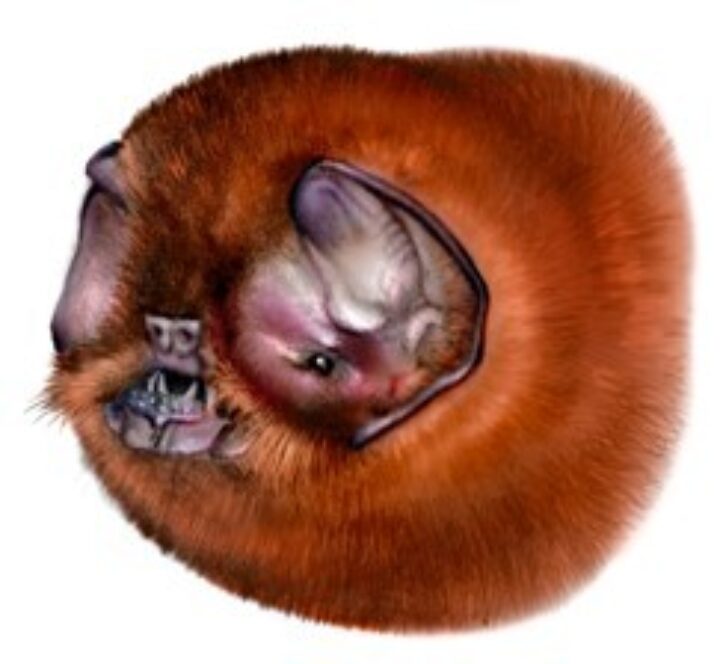
Figure 2: Antillean Ghost-faced Bat (Mormoops blainvillei), illustration by Adrián Tejedor.
Islands are home to around 20% of the world’s biota, yet their small size makes their inhabitants especially sensitive to disruption from devastating weather events and human interference. As a result, extinction (the total eradication of a species) or extirpation (the extinction of one population of a species, while populations of the same species persist elsewhere) are common on islands.
The Caribbean hosts enormous biodiversity but has seen many extinctions. Before temperatures and sea levels rose around 11,000 years ago, the Caribbean hosted 99 species of native non-flying mammal, as well as 51 species of bat. Changes to the climate, combined with human colonisation over the last few centuries, has resulted in a huge loss of species; only 13 native non-flying mammals and 41 native bats still exist.
Within the Caribbean region there are different types of island; from the low-lying Bahamas with beautiful white sand beaches, to St Lucia and Dominica with their active volcanoes, and the mountainous Jamaica made of ancient crust. This wide variety of island exists because the Caribbean has had a complex geological history mixing volcanic, plate tectonic and sedimentary processes. Such biodiversity and complexity within a relatively small area makes the Caribbean perfect to investigate extinction risk in bats [Fig.3].
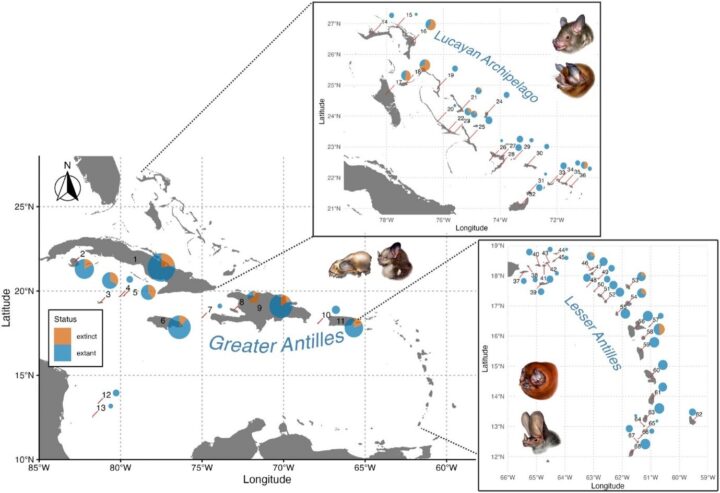
Figure 3: Map of the Caribbean Islands. Islands studied are numbered 1 – 68 and the scale of the pie charts is proportional to the total number of bat species on the island with the proportion of extant (living) (in blue) and extinct/extirpated (in yellow) species shown. Illustrations are examples of extinct/extirpated bat species from the regions. From Rayfield et al. (2026).
The researchers of this study collected data on factors expected to affect the resilience of bats over time. The existence of Caribbean fossil bats means we know important information such as which bats lived where in the past, how big they were, and if they went extinct. Data collected for the study included living and fossil bat characteristics (intrinsic traits)—such as body size, roosting habits and diet—as well as environmental factors (extrinsic traits)—such as island elevation, island area, amount of deforestation, hurricane frequency, time of first human arrival. With this knowledge, Rayfield et al., modelled how each trait influenced the probability of survival of a population through time.
“For a lot of extinct species, we have remains that can help figure out the size but for some bats the remains are not […] enough […]. In our paper we show that we can use the [bat evolutionary tree] to infer the body mass.”
Flying Away
Of the intrinsic traits modelled, body size was found to influence resilience most, with medium bat species (those weighing ~9–22 g) having the lowest probability of survival—the opposite trend to Caribbean non-flying mammals [Fig.4].
Small non-fliers (e.g., moles) are hunted by invasive species brought over by humans, whereas larger non-fliers (e.g., sloths and monkeys) have been hunted by the humans themselves for sport or food, making medium-sized non-flying mammals (e.g., hutias) just the right size to persist amidst disruption. All bats are technically ‘small’ when considered amongst all mammals, but a similar pattern to non-flying mammals was expected to emerge within the range of bat size. Clearly, something else is at play.
Larger bats can fly longer distances, meaning they are likely to be extirpated rather than completely eradicated as they can fly back later. On the other hand, although small bats can’t fly far, they are too tiny to be of interest to invasive predators. This leaves medium-sized bats disproportionately likely to go extinct, as their size means they are big enough to be eaten but too small to fly to safety (Fig 5).
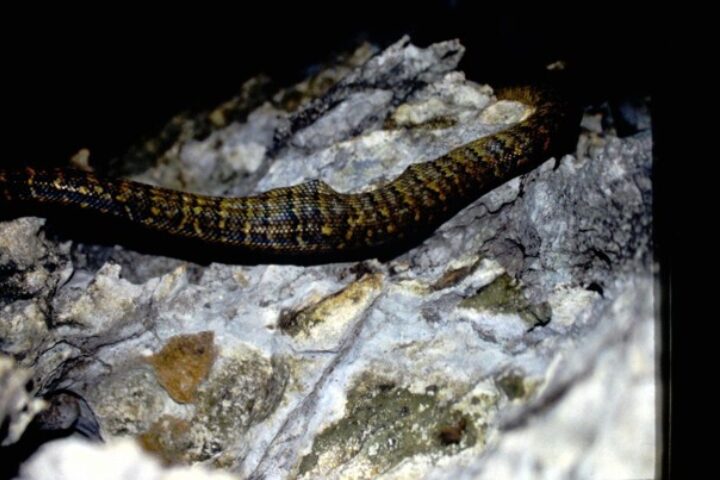
Figure 4: Jamaican boa (Epicrate subflavus) digesting a Caribbean bat at Ratbat Hole, Botany Bay, St. Thomas, Jamaica in 2001. Picture taken by Liliana M. Dávalos
This pattern was found to be closely linked to two extrinsic traits—island elevation and island area—working together to decide the survival probability of different bat populations.
“Surprisingly, bats defied our prediction, rather than being buffered from extinction, intermediate sized bats were disproportionately vulnerable. This unexpected pattern prompted us to reconsider how intrinsic traits such as body size interact with ecological characteristics”
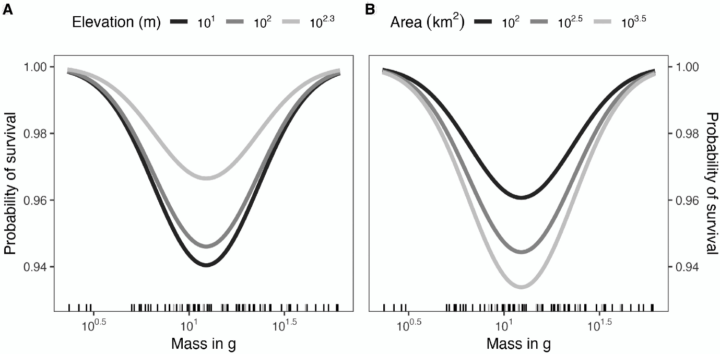
Figure 5: Graph lines showing the probability of survival (vertical y-axis) for different body masses of bats (horizontal x-axis) on islands with different elevations (A) and land areas (B). Elevations in (A) are 10 m (black line), 100 m (dark grey line), 200 m (light grey line) and land areas in (B) are 100 km2 (black line), 315 km2 (dark grey line), 3160 km2 (light grey line). The u-shaped trend shows that intermediate sized bats (~ 10 g) have the lowest probability of survival across all island elevations and areas, with smaller (~ 3 g) and larger (~30 g) bats having a higher probability of survival. From Rayfield et al. (2026).
Gone When the Morning Comes
Greater average elevation and smaller island area increases survival probability of all bats. Higher elevations offer refuge from storms and floods that devastate roosting locations in low-lying areas. Bats on smaller islands often have populations elsewhere and so can be repopulated later by a bat from another island, while larger islands more commonly harbour unique species, so once they’re gone, they’re gone.
The rate of deforestation and introduction of invasive species like feral cats and mongooses, which prey on modern bat populations, greatly increased after colonisation. Usually, larger island area would increase survival probability because larger populations are more resistant to extinction, however they tend to experience greater levels of invasive predator introduction and habitat loss by deforestation. By the end of the 19th century, many Caribbean islands had lost most of their forests, and today deforestation continues to impact bat populations.
There’s Always Gonna be Some Light
Intrinsic traits, extrinsic traits, and a long history of human-induced environmental destruction have shaped, and will continue to shape, Caribbean bat survival patterns. However, the authors of the study emphasise that “understanding how body size and island characteristics influence survival could help identify species or island ecosystems that may be more vulnerable to extinction, providing useful information for prioritizing conservation efforts”. They believe “this study could also be applied to bats in places beyond the Caribbean” and are interested in exploring how “disturbances of the past continue to shape extinction patterns today, and how this knowledge can inform conservation of Caribbean fauna more broadly.”
“[I]ncorporating more of the environmental archaeological record to understand how the Caribbean has changed over time due to human influence […] could provide valuable context for understanding the conservation challenges these species face today.”
Guest Blogger
Written by Lucy Jackson. Lucy is a PhD candidate at the University of Reading and the Natural History Museum. Before beginning her PhD in Evolutionary biology and Palaeontology, Lucy completed a degree in Geology. She is particularly interested in how the variety of body plans within the animal kingdom that we see in the world today came about. Her current research involves studying fossils using X-ray CT-scanning and building evolutionary trees to unravel the early evolution of echinoderms (starfish and sea urchins) over 500-million years ago during the famous 'Cambrian explosion'. She is passionate about engaging people with natural history and communicating science to a wide range of audiences. Edited by Georgia Cowie.

Paper Author: Dr Kristen M. Rayfield
Dr Kristen M. Rayfield is a Postdoctoral Fellow at Stony Brook University working with Dr Liliana M. Dávalos. Her research background is in archaeology and historical ecology, using ancient DNA techniques to investigate long-term human-animal-environment interactions. She is interested in how human activities have shaped animal populations and ecosystems over time, and how these past interactions continue to influence biodiversity today. This study provided an excellent opportunity to apply that perspective to Caribbean bats by exploring how body size and island characteristics, alongside human disturbance, contribute to patterns of extinction. As someone relatively new to bat research, she also enjoyed the opportunity to learn more about the diversity of Caribbean bats and their important ecological roles while connecting the study to her broader interests in human impacts on biodiversity and conservation.

Paper Author: Liliana M. Dávalos
Liliana M. Dávalos is a Professor at Stony Brook University’s Department of Ecology and Evolution. Her lab exists to understand what makes biodiversity unique and implications thereof. How most other mammals of the Caribbean went extinct while most bats live to this day has been an important question for many years. Thanks to a SESYNC project, she was able to team up with collaborators to arrive at the answer in a previous paper as well as this one. Building on the strengths of this collaboration and Dr. Rayfield’s disciplinary background, our team now aims to explore the human dimensions linked to the mass mammalian extinction event in the Caribbean Islands, as well as cultural practices associated with biodiversity resilience.