Beyond Greek and Latin
How scientific names can be vaults of history, culture and heritage. Written by guest blogger Manasee Thisaramalee Weerathunga.
Published on 12th October 2026
Have you ever looked at all the unfamiliar scientific names in your science textbooks and thought “It’s all Greek to me!”? Guess what…that might be because it is Greek! Taro Yoshimura’s latest study, published in the Zoological Journal of the Linnean Society, demonstrates this profound bias by revealing that 71.8% of family names of Phylum Mollusca, the soft-bodied snails, slugs, clams and squid, have Ancient Greek roots.
Why Do We Really Need Scientific Names?
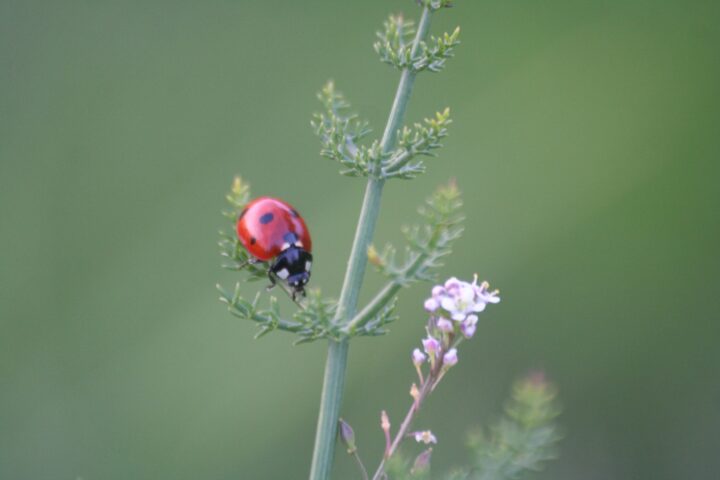
Before Linnaeus established scientific nomenclature, common names for species such as this ladybird were often confusing and inconsistent across countries, languages and dialects.
Science, like music, is a universal language. Scientifically naming organisms is one way of making science universally comprehensible. However, outside of science textbooks we all learnt our first animals, birds and flowers with their common names. Yet, these vary across countries, languages and even dialects. If a British English speaker talks about a ladybird, some might not realize that they are referring to the tiny, black spotted, red insect – which in American English is called a ladybug. The common name “robin” refers to two different bird species in Europe and North America. To avoid this kind of confusion the scientific community came up with scientific nomenclature centuries ago. Established by Carl Linnaeus in the 1700s, this system identifies every organism with a two-part Latin name, governed by an internationally agreed rule set. They are often inspired by impressionistic touches such as mythology, literature and accolades as well as realistic elements like ecology, morphology, behaviour and geography. By using scientific names, scientists worldwide can be on the same page regardless of language or geography.
Japan Has Their Own Special Way
For naming organisms, the Japanese have a well-established vernacular system – the Wamei. Used concurrently with scientific names in domestic peer-reviewed journals, conference presentations and local field guides, Wamei names are an integral part of Japanese science. Taro Yoshimura, a Japanese mollusc researcher, noticed something intriguing when working with both vernacular Wamei and standard binomial nomenclature. While scientific names lean more towards morphological descriptions Yoshimura observed Wamei names being more impressionistic, capturing poetic, emotional and historical relationships between the organisms and humans. He illustrates this difference with a marine clam species, scientifically named Cultellus attenuatus, meaning “small, tapering knife” describing its razor-shaped shell. Contrastingly, its Wamei name, Yukinoashita, means “morning of light snow”, inspired by its white-mottled, brown shell. While the Latinized scientific name is straightforward and universally comprehensive, the Wamei name brings in an aesthetic touch that makes it more resonant even with people who are not experts in science. This aloofness of scientific names, which also makes them many students’ nightmare, was a major catalyst that prompted Yoshimura to dig deep into the linguistic and historic roots of all 773 family names of Phylum Mollusca.
Why Did it Have to be Latin or Greek?
In this study, Yoshimura uncovers ‘Taxonomic Graecism’, which is the dominance of Ancient Greek roots over Latin in scientific names of mollusc families. Linnaeus established scientific nomenclature building on Latin which was the working language of administration, law and
scholarship across Western Europe at the time. Greek, the language spoken by visionary philosophers like Plato and Aristotle, was acclaimed as the language of intellectual originality and superiority. This likely prompted the Greek-biased names to boom in the 19th century.
The lengths that 19th century Western European taxonomists seem to have gone to raise their nomenclature to a prestigious pseudo-Greek stature is fascinating. They would add unnecessary h’s to names which correctly would have sounded ‘k’, so the names would sound like ‘kh’ with an aspirated h – as in Ancient Greek letter χ (chi). Mollusc taxonomists of the time also have used this “h makeup brush” liberally to stylize the Latinized versions of scientific names in Greek fashion, so that they would gain higher scientific legitimacy.
Camaraderie and Greek Gods Make Scientific Names Human
Scientific names carry heavy imprints of personal and cultural biases, although it was a system introduced to neutralize taxonomy. The spike of Greek dominance in scientific names during the 19th century is a snapshot of the skewed ethnic and gender demographics monopolized by male taxonomists hailing from Europe and North America at the time. Proficiency in Greek and Latin was considered the epitome of gentlemanly scholarship in Europe at that time. Hence, the hegemony of a few European nations like the UK and France and underrepresentation of women and Global South in mollusc taxonomy is mirrored in the linguistic climax of Greek-rooted scientific names. This power asymmetry in the history of taxonomic research is also exhibited by authors choosing others of the same gender and country when naming organisms in someone’s honour.
Early taxonomists relied heavily on external features to identify organisms. Hence, morphology appears to have inspired the majority of mollusc family names, followed by ecology. Interestingly, Greek mythology also occupied a significant portion, a trend that synchronises with the historical period when taxonomists were attempting to decorate natural history with culturally and scholarly elite Greek. Triton, the mighty king of the ocean was brought into scientific names to represent habitats while the beauty of Venus inspired names of shimmering shells. Taxonomists added these Greek-inspired poetic touches to enhance scholarly prestige and legitimacy.
These patterns demonstrate that scientific nomenclature was a system that was governed through closed national networks while being neither completely neutral nor devoid of personal touches.
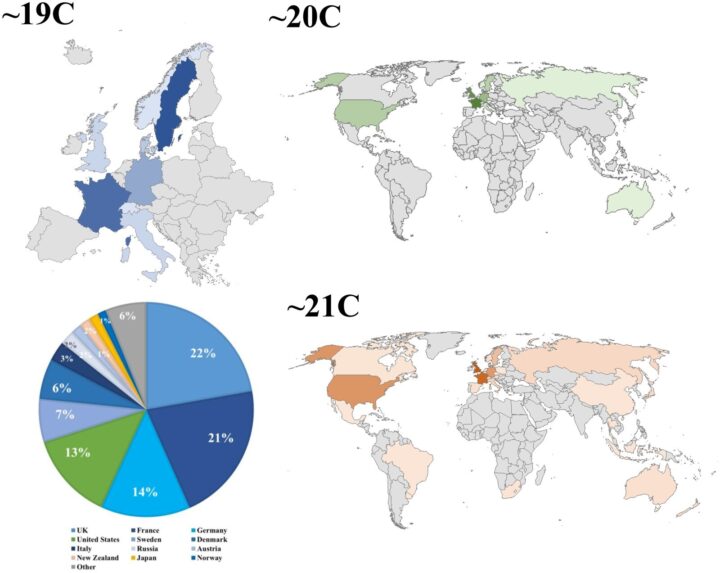
Figure 1: Changes in the nationality of describers over time. Countries whose researchers contributed to descriptions are coloured on the map, with the intensity of the colour indicating the number of individuals in proportion. Colours in the pie chart are standardized to shades of blue for European countries. Taken from Yoshimura, 2026.
Let Scientific Names Carry Stories
The cultural, geographic and linguistic diversity of molluscan scientific names has significantly shifted towards more collaborative and diversified waters with the dawn of the 21st century. Yet the historically-laid solid foundation of Ancient Greek still grounds the molluscan scientific name emporium to Global North, with Western authors in at the throne. Remodelling this structure for a more diversified architecture could cost stability, neutrality and accessibility. The international guidelines for nomenclature are flexible about linguistic origin, while recent advancements in machine learning and digitization eases translation and cross-reference between languages. Hence, Yoshimura invites modern taxonomists to weave in indigenous knowledge, folklore, local words and personnel, into the existing structure when naming organisms. That way scientific names would be vessels carrying heritage across time and space.

Guest Blogger
Manasee Thisaramalee (she/her) is a Sri Lankan biologist and science journalist, currently pursuing her PhD in Biology at University of Florida, USA. Her favourite part of work is writing — whether it's in code for computers to read or words for people to read. Her research involves mining through public databases, extracting information and analysing phylogenomic histories and evolutionary patterns in red and green algae, using computational and bioinformatic methods. She is also passionate about writing to science journalistic platforms to showcase scientists and their research from diverse backgrounds, communicating their unique experiences, challenges, and the stories behind each journey, to enhance diversity, equity and inclusion in science. Edited by Georgia Cowie.
About the Author
Taro Yoshimura is a researcher in evolutionary palaeontology at The University Museum, The University of Tokyo (UMUT). While his broader work investigates molluscan biomineralisation, he is also deeply engaged in the history and linguistic landscape of biodiversity. An avid collector of shells since his early childhood, Taro's fascination with taxonomy was truly ignited at the age of seventeen, when he published his first paper describing a new species of fossil bivalve. Parallel to his scientific career, he has practised traditional Japanese tea ceremony and karate since a young age, and today serves as a qualified instructor in both disciplines. This lifelong immersion in both cultural arts and natural history sparked his deep interest in the intricate relationship between culture and living organisms, ultimately inspiring him to expand his research into the history of science. By examining the human choices behind taxonomy, Taro’s work explores how cultural traditions and epistemic values have historically shaped—and continue to shape—global scientific nomenclature.