The Lonely Eucalyptus
Botanists use DNA to investigate which rare plants are worthy of protection? Written by guest blogger Kelly Kirkland.
Published on 14th September 2026
When a bee collects pollen from a eucalyptus flower, and transfers it to another eucalyptus flower, the result is a baby eucalyptus tree that is the same species as the parents...right? Not so fast. It turns out that plant paternity is tricky business. Many plants, including eucalyptus, can reproduce with plants from related but different species to create successful seedlings, resulting in hybrids.
Studying this isn’t just a fun taxonomic exercise. It matters how humans define a species because that makes all the difference in how conservation laws are applied. How can you protect rare species if it’s unclear how many species even exist?
At The University of Western Australia, Dr. Rachel Binks and her team of researchers have been digging into the parental histories of some very similar eucalyptus trees. In her recent paper, published in the Botanical Journal of the Linnean Society, she revealed some important distinctions.
Downright Confusing
While there are more than 700 species of eucalyptus tree on the planet, only some of them are rare or endangered. In the absence of clear data about exactly how many species there are, scientists have erred on the side of caution, giving anything that looks a little bit different its own species name.
Scientists hone in on some key features to differentiate Eucalyptus trees: their growth habit (overall shape), the shape and colour of their fruits, and the shape of their seeds.
It’s possible those visual differences represent unique and even endangered species worthy of protection. But it could also be simply a rarely occurring hybrid, a happy little accident that isn’t going to reproduce. If conservation efforts tried to protect those plants solely on the basis of being rare, they would be barking up the wrong tree.
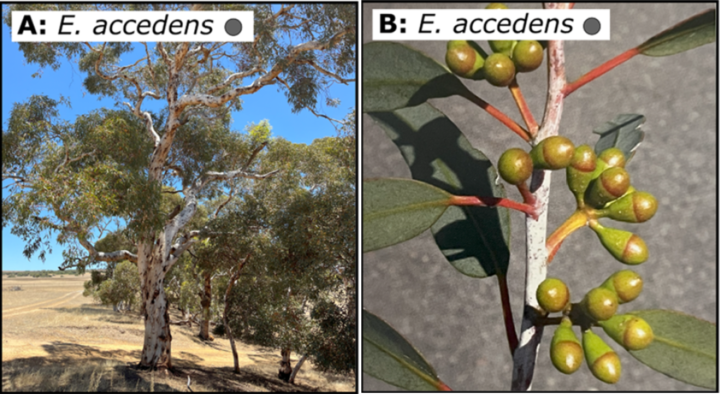
Figure 1:Eucalyptus accedens, also known as the Powderbark Wandoo, is one of the trees that scientists suspected was creating hybrid offspring with its close relatives.
A Fraught Family Tree
Researchers suspected that three named species (E. crispata, E. pruinarims, and E. leprophloai) were actually just hybrids descended from E. accedens mixing with other species.
To test this, the team collected over 100 samples of fresh leaves and analysed their DNA. Some of their hybrid hypotheses were confirmed, but not all.
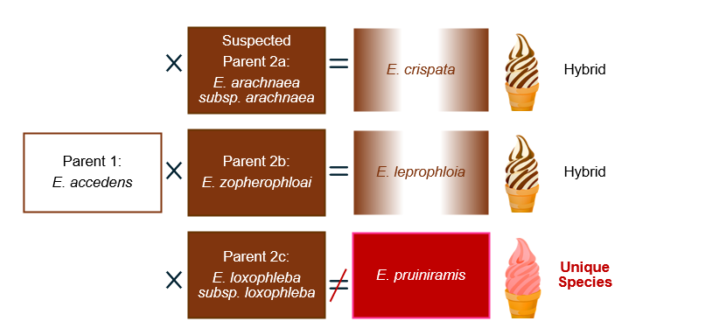
Figure 2: Expected parents. Of the three crosses expected, only two were found to create hybrids. The third expected cross was not borne out by DNA testing. The end result leaves 5 unique eucalyptus species, those in solid-coloured boxes.
For the first two pairings, they found that their hypothesis was correct. E. accendens and two closely-related but unique species (E. arachnaea subsp. arachnaea and E. zopherophloai) were occasionally reproducing to create hybrid offspring. Importantly, almost all of the DNA sampled revealed a fresh combination of genes from the original two parent species. That means the hybrids weren’t reproducing on their own, but were each the result of one-off hybridization events, happy accidents. It’s a little bit like a chocolate-vanilla swirl ice cream cone. It might be listed separately on the menu but it’s not a brand new flavor; it’s always two flavours mixed together. These are called transient hybrids.
E. pruiniramis, on the other hand, is it’s own flavour. Genetic analysis showed that, even though it lives in many of the same areas as E. accedens, they aren’t connected in a hierarchical relationship like a family tree. It’s not a hybrid at all. These species are still in the same genus, but due to their visible and genetic differences it makes sense to leave them defined as separate species.
Disowned?
Now that the genetic relationships are clearer, it’s important that this research makes it into policy. To get protection under Australian law, a hybrid plant must meet three criteria: 1) it must occur naturally without human intervention, 2) the hybrid children must look the same as each other and different from their parents and 3) they must be able to make their own viable seeds (without additional hybridization with close relatives).
The hybrid offspring fail this test. E. crispate and E.leprophoia don’t meet the above criteria, so researchers recommend that their unique species names be retired. That change would represent a really helpful advancement. Rather than spend precious conservation dollars on the wrong tree, this clarity can help ensure protections are put in place where genetic diversity needs it most.
Conclusion
Thanks to the detailed molecular analysis conducted by the research team, the picture is clearer: five rare eucalyptus in Western Australia deserve to be considered unique species, and two previously-named species can be more accurately categorized as transient hybrids.

Guest Blogger
Written by guest blogger Kelly Kirkland. Kelly is a postgraduate student in science communication at Imperial College London, with an interest in ecology and natural history. She grew up in the tidepools, orchards and temperate rainforests of the Pacific Northwest and is curious about everything in nature. Edited by Georgia Cowie, Journal Officer at the Linnean Society.
About the Journal
This blog was inspired by a paper published in our Zoological Journal, an international journal publishing high-quality papers covering systematic & evolutionary research from species both alive and extinct. Want to contribute to a blog? Contact the Journal Officer directly.