Hidden Caves: Cape Verde's Secret Sponges
How scientists’ submarine cave exploration uncovered five new species of marine sponge in Cape Verde. Written by guest blogger Lily Fallows.
Published on 17th August 2026
Tucked out of sight in submarine caves are a class of shade-loving sponges called Homoscleromorpha. The inaccessible nature of their habitat means the number of identified species of this sponge class is far fewer than the reality. A recent study, published in the Zoological Journal of the Linnean Society, set out to uncover these elusive homoscleromorph sponges hidden in the underwater caves of Cape Verde. The findings revealed valuable insights into the complex evolutionary history of these creatures.
Homoscleromorpha: Life in the Dark
Sponges are stationary marine animals that act as one big filter, feeding on the nutrients within the water. Homoscleromorphs are a brightly coloured class of sponge, with a smooth yet irregularly formed surface. Often underestimated, uncovering the true number of species hiding under the water can help scientists build a picture of their wider evolutionary history and the processes that have helped to build the marine ecosystems present on our planet today.
Scientists have been confronted by the challenging taxonomy of homoscleromorphs for decades. From cytology (the study of cellular structures) to morphology and DNA analysis, advancements in such taxonomic approaches aid scientists in this struggle. Yet, even with these tools, vast amounts of data that can improve our ability to classify homoscleromorphs remains missing due to the inaccessible nature of these habitats.
Archipelago Adventures
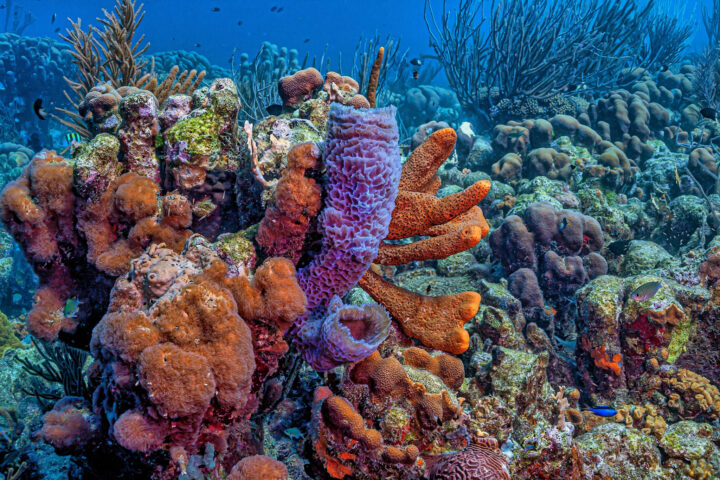
Within the Eastern Atlantic Ocean lays Cape Verde, a tropical archipelago complete with an extensive network of submarine caves. Whilst this is the ideal habitat for homoscleromorphs, these caves remained unexplored by experts until August 2022, when SCUBA divers collected sponge samples from rocky cave surfaces. It then wasn’t until 2026 when Cabioch et al. published their study that the full taxonomic analysis was shared, revealing five new sponge species discovered.
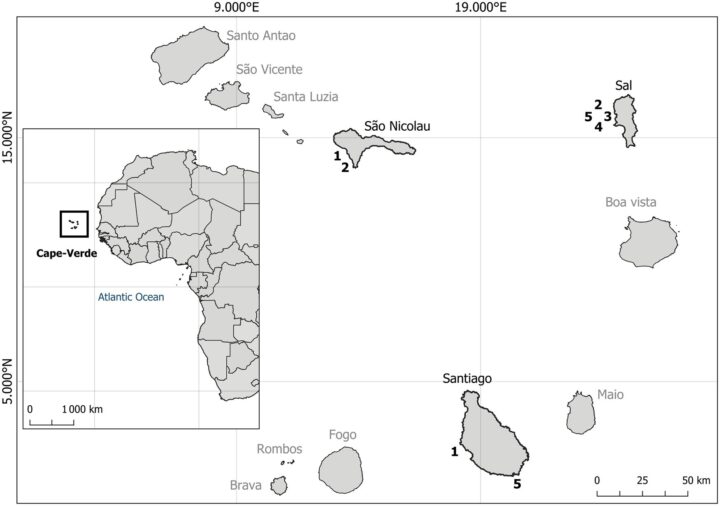
A map detailing the sample sites where the five new Homoscleromorpha species were discovered across the Cape Verde Archipelago. From Cabioch et al. (2026).
Morphology and Molecules
Only after diving through caves and scraping off the sponges could the real challenge begin: taxonomic assignment. Species identification is no simple feat, especially for sponges. For instance, the physical characteristics of separate sponge species can’t always be relied on for taxonomy, as totally unrelated species often evolve similar physical traits. To tackle this, Cabioch et al. combined molecular analyses, such as DNA and cellular analysis, with morphological and anatomical analyses to unpick this taxonomic puzzle.
One of the new species detailed within this research is Oscarella antea. Unique in that it completely lacks a skeleton, its identification relies primarily on examining its cellular structures. What’s more, some of this species’ internal anatomy doesn’t align with other Oscarella species, proving to be more of a challenge in analysis. It has much thicker ectosomes—small packages that cells release to communicate to one other—than other members of the Oscarella genus. As a result, researchers had to search for other distinguishable cellular structures to confirm their specimen as Oscarella. Cabioch et al. explain how this demonstrates the necessity of extensive, in-depth, cellular studies for taxonomic assignment within the Oscarellidae family.
Brand New Species
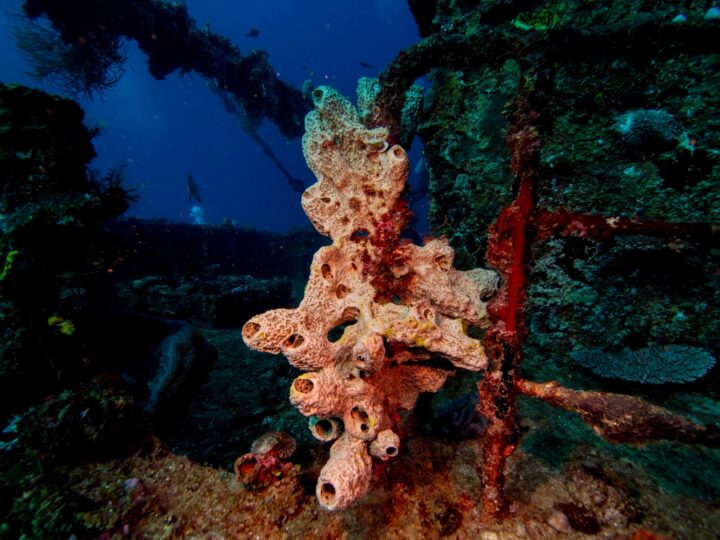
Sponges can come in all shapes and sizes. Here is a large sponge growing on a ship wreck.
An exciting aspect of this study was the identification of an entirely new genus Aspiculina, incorporating the newly discovered species Aspiculina malanoba. This identification required a combination of tissue analysis, cellular structure analysis, and genetic sequencing. Interestingly, when certain analysis methods were considered in isolation, support for classifying the presence of a new genus was unclear. As such, this highlights the importance of considering multiple lines of evidence in tandem to untangle complex taxonomic questions.
A rather heartwarming detail of the A. malanoba story is the origin of its name. Derived from “Ma la nob”, translated as “I love you” in Senegalese, it is described as a love letter to Cape Verde by the researchers.
Finally, three new species belonging to the Plakinastrella genus were identified: Plakinastrella fauvelotae, Plakinatrella freitasi and Plakinastrella cachupa. These species do in fact have skeletons, which allowed the researchers to incorporate skeletal analysis into the taxonomic assignment process.
This method primarily focussed on structures known as spicules, tiny skeletal support components found in many sponge species. Spicules come in a variety of shapes and sizes, making them useful structures to analyse for taxonomic assignment. Cabioch et al. examined the spicules of each specimen they collected to distinguish whether they belonged to the Plakinastrella genus—recognisable for most commonly having a combination of spicule types. Figure 2 displays the spicules present in just one of the Plakinastrella species discovered. The team used a new statistical method to estimate spicule size, introducing a new level of precision to Homoscleromorpha species identification and potentially helping to reduce species misidentification in future taxonomic studies.
A New Perspective on Sponges
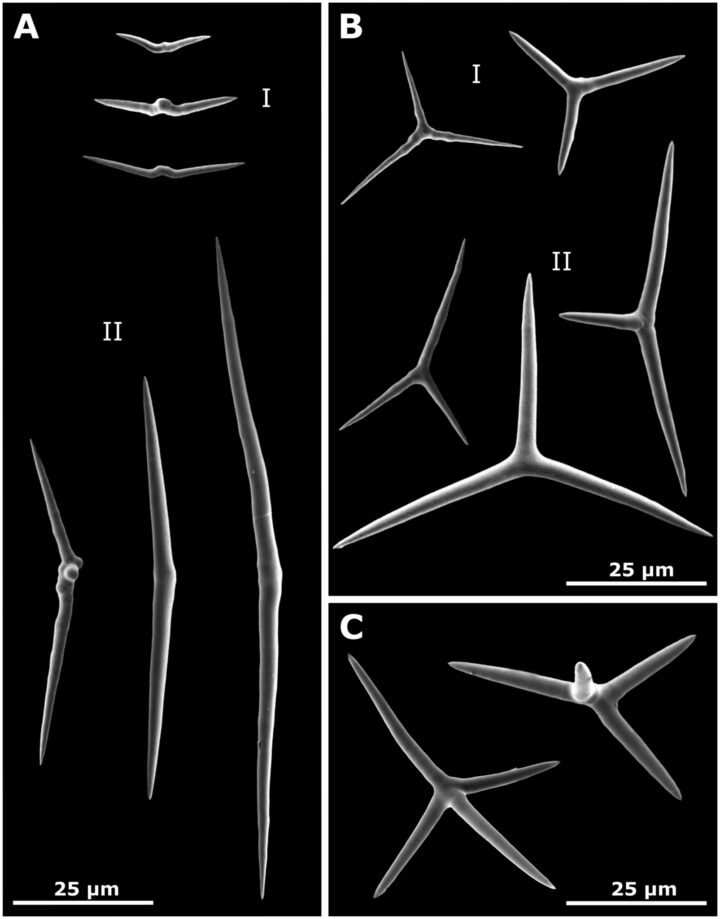
An image showing microscopic structure of the primary spicule types found in Plankinastrella fauvelotae. From Cabioch et al. (2026).
At the surface, this research represents the exciting discovery of several new species once hidden in the darkness. More importantly, it points to the vast amounts of undiscovered biodiversity that may remain in Cape Verde and other unexplored marine habitats. This study demonstrates just how important an integrative taxonomic approach is when identifying new sponge specimens and emphasises the opportunity for such methods to be applied to further Homoscleromorpha research.
Ultimately, sponges were some of the first animals to live on this earth and understanding their true ancestry could unlock surprising evolutionary secrets. Studies like this one can help us get there, five sponges at a time.

Guest Blogger
Written by Lily Fallows, a BSc Biology graduate from the University of Nottingham who is currently undertaking an MSc in Science Communication at the University of the West of England. Whilst she is interested in topics such as genetics and conservation, her true passion lies in how we effectively communicate both fascinating and important scientific information with the world. She believes that inspiring diverse audiences to connect with science in more deep and meaningful ways is more important now than ever before. Edited by Georgia Cowie.
About the Journal
This blog was inspired by a paper published in our Zoological Journal, an international journal publishing high-quality papers covering systematic & evolutionary research from species both alive and extinct. Want to contribute to a blog? Contact the Journal Officer directly.