Facial Reconstruction: Bringing New Life to a 66-Million-Year-Old Salamander
How CT scanning can fill gaps in the fossil record to tell a new evolutionary story. Written by guest blogger Juliet Maxted.
Published on 7th August 2026
A giant salamander from the Late Cretaceous, Eoscapherpeton asiaticum, is considered the oldest species of cryptobranchid. Yet, the fossil record is poor, so understanding the evolution of this ancient, but remarkably unchanged, lineage has been challenging. A new study, published in the Zoological Journal of the Linnean Society, seeks to shed a light on the cryptic evolutionary history of cryptobranchids by combining fragmentary fossilised skull bones to create the first complete model skull of E. asiaticum.
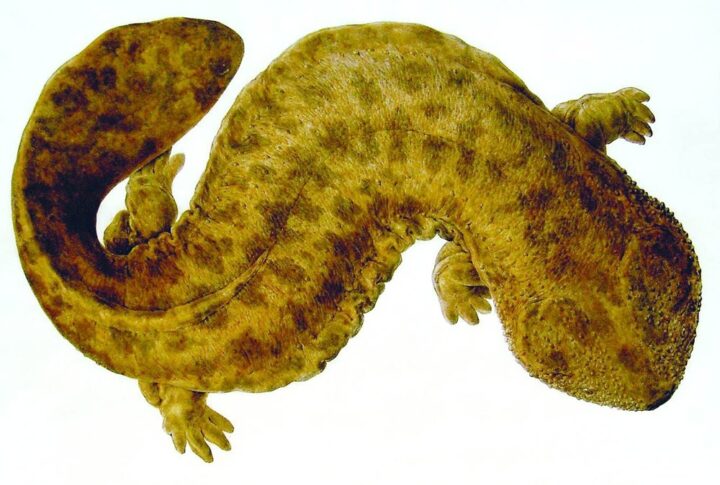
Japanese giant salamander Andrias japonicus, Siebold Collection, Naturalis, Leiden. Taxidermied salamander. Naturalis Biodiversity Center/Wikimedia Commons. Public domain under CC0 1.0.
Why This Species?
E. asiaticum is important because it is the type species that defines the oldest cryptobranchid genus: Eoscapherpeton. Research on its fossil record has not previously focused on skull anatomy. In fact, just one incomplete skull reconstruction has been published so far. However, skulls can provide particularly valuable evidence for reconstructing an extinct species’ ecological niche. This study aimed to fill this research gap by fully describing the cranial anatomy of E. asiaticum. By creating a complete skull reconstruction, Kolchanov & Skutschas aimed to shed new light on two questions: (i) how did this species behave and (ii) how have cryptobranchid skulls evolved since the Cretaceous?
Using CT Scanning to Reconstruct a Skull
There are no surviving complete skulls of the cryptobranchid E. asiaticum. Instead, this study reconstructed the skull using CT scans. To achieve this, three fragmentary skulls were scanned, alongside other isolated and articulated jaw bones to fill in missing areas in the fragmentary skull specimens. The CT images were stitched together to create a complete 3D model. To understand how skull anatomy has changed over time, the model was then compared to the skulls of extant (surviving) cryptobranchid species.
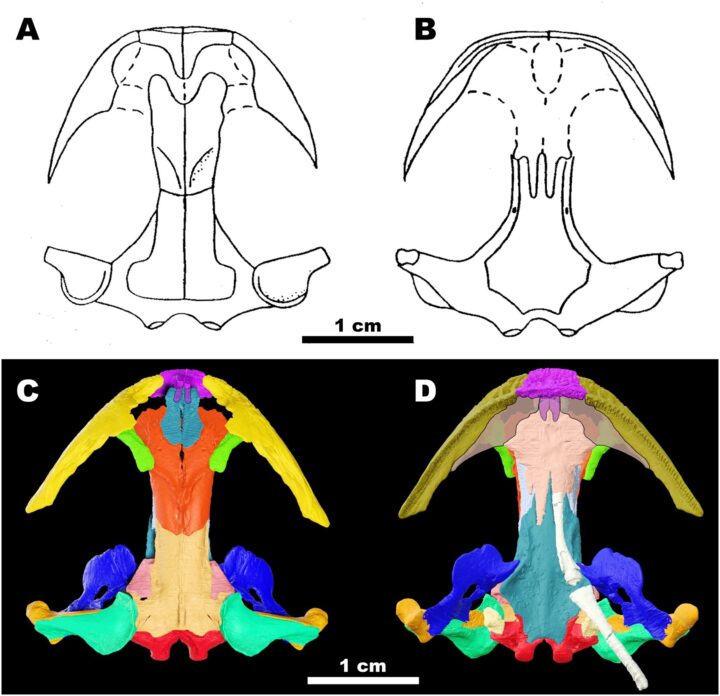
(From Paper) Reconstructions of the skull of Eoscapherpeton asiaticum. A, B, previous reconstruction of the skull (Nesov et al. 1996, with alterations) in dorsal (A) and ventral (B) views. C, D, reconstruction of the skull based on CT scanning and modelling (this work) with mandibles removed, in dorsal (C) and ventral (D) views.
Bringing Eoscapherpeton asiaticum Back to Life
Analysing the reconstructed skull has yielded new insights into how E. asiaticum might have behaved. Features seen for the first time in this reconstruction, such as a complete hyobranchial apparatus, suggest that E. asiaticum was fully aquatic. The large, ossified, horseshoe-shaped structure is used by modern cryptobranchids to generate suction force, dragging their prey into their mouths. The shape and size of this apparatus is similar to that of modern cryptobranchids, which indicates that E. asiaticum used the same suction feeding method to hunt.
The reconstructed skull also shows numerous neurovascular canals (grooves for cranial nerves and arteries) in the same region as lateral line organs found in cryptobranchids. This points to E. asiaticum having a well-developed lateral line, a sensory receptor that detects vibrations, currents and electrical signals in aquatic environments. However, unlike lateral lines in modern cryptobranchids, E. asiaticum has a robust ridge on the top of its skull. Previous research attributed this feature as an adaptation for burrowing, but Kolchanov & Skutschas proposes a more robust conclusion based on the newfound evidence for a lateral line.
As Above, So Below: Hunting in the Depths
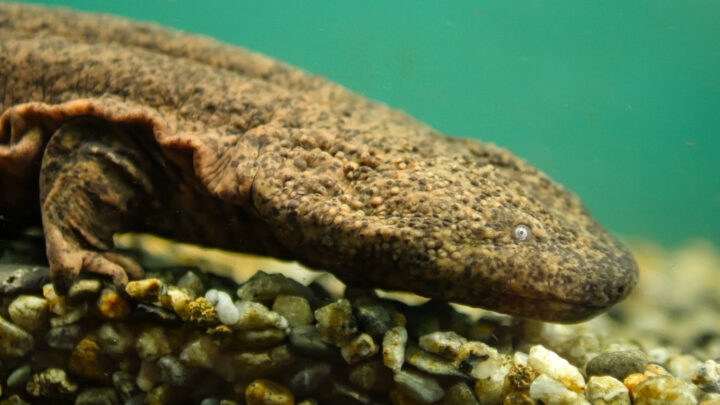
Japanese giant salamanders (pictured) are extant cryptobranchids, reaching up to 5 feet long. Though related to E. asiaticum, they are more adapted to ambush prey capture.
This cranial ridge may, instead, have formed part of a sensory system unique to E. asiaticum, acting as a screen within the lateral line. This could have allowed the salamander to ignore sensory signals from above and direct their sensory organs to identify prey hidden in the sediment below them. This evidence indicates that E. asiaticum was an active, bottom dwelling predator.
There are further major differences between the reconstructed E. asiaticum skull and that of modern cryptobranchid species. E. asiaticum lacks the specialised feeding strategies found in modern cryptobranchids; although it has a flattened skull, it’s nothing compared to those of modern salamanders. Modern species also have additional jaw modifications that allow them to move their jaw asymmetrically to capture prey more precisely.
What Does This Mean?
Through describing the complete skull of E. asiaticum for the first time, this study has managed to make new inferences into the evolution of cryptobranchid salamanders. Early cryptobranchid species had evolved partial modifications for hunting sediment-dwelling prey underwater using suction. Over time, cryptobranchid species gradually increased in body size, allowing them to hunt larger prey. In order to do so, they evolved more specialised adaptations for precise, energy-efficient suction feeding. Since they were no longer exclusively hunting small bottom-dwelling prey, cryptobranchids lost the modified ridge in the lateral line, and became slow moving ambush predators that hunt for large prey in water column.
Why Is This Important?
Cryptobranchids have survived for millions of years, slowly adapting to become specialised for their unique environment. Uncovering the fascinating evolutionary history of cryptobranchids is one way of showcasing their value as members of a lineage that represents a deep (pun intended) and unique evolutionary history. By understanding the environmental pressures that may have shaped modern cryptobranchids we can learn about how best to protect the vulnerable populations that exist today.
Guest Blogger
Written by guest blogger Juliet Maxted. Juliet has an academic background in Zoology and Conservation Science. She is currently studying for an MSc Science Communication at Imperial College London. She is passionate about natural history and about finding new ways of engaging people with nature. Edited by Georgia Cowie.
About the Journal
This blog was inspired by a paper published in our Zoological Journal, an international journal publishing high-quality papers covering systematic & evolutionary research from species both alive and extinct. Want to contribute to a blog? Contact the Journal Officer directly.