The Architecture of Enormity
How the skeleton of an early dinosaur provides a window into the evolution of the Sauropod neck. Written by guest blogger Beth Taylor.
Published on 5th June 2026
At one point or another, we’ve all naturally had to confront the same question: how can I achieve complete ecological dominance in the Mesozoic? Sauropodomorphs appear to have answered that question with excessive neck length and a complete disregard for sensible body proportions.
Sauropodomorphs are the dinosaur group that includes both the giant sauropods and their smaller, earlier relatives. Although species such as Diplodocus, Brachiosaurus and Argentinosaurus became some of the largest animals ever to walk the Earth, the foundations of their body plan evolved much earlier in comparatively small-bodied ancestors.
In a recent study published in the Zoological Journal of the Linnean Society, Fonseca and colleagues examined the axial skeleton (the skull, vertebral column, ribs and associated structures) of the early sauropodomorph Macrocollum itaquii. Their findings suggest that several defining sauropod features were already evolving more than 220 million years ago, long before true sauropods reached gigantic sizes.
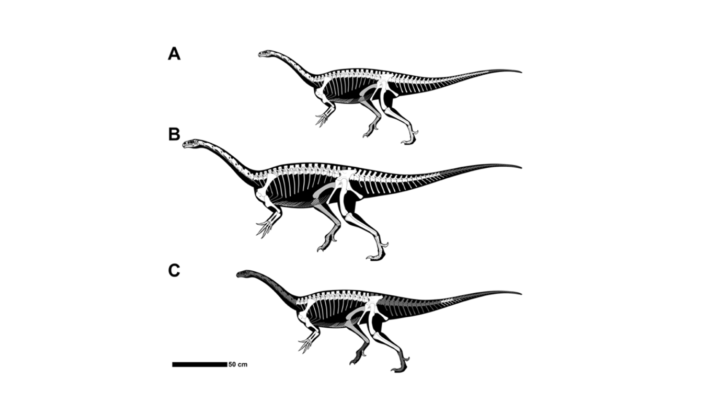
Figure 1: Skeletal reconstructions of three Macrocollum itaquii specimens. White bones indicate fossil material that was preserved and recovered.
Meeting Macrocollum
When most people picture a sauropod, they imagine a gigantic four-legged herbivore slowly moving through Jurassic forests. Macrocollum looked very different.
Small, lightly built and probably moving on two legs for much of its life, Macrocollum lacked many of the extreme adaptations associated with later giant sauropods. Yet it occupied a crucial position in sauropodomorph evolution. It represents an early branch of the lineage, preserving a mixture of ancestral traits and primitive, emerging innovations.
This combination makes it particularly valuable for understanding how the famous long-necked giants evolved from much smaller ancestors. Primitive features included its modest body size, bipedal lifestyle and a conservative number of vertebrae.
Yet hidden within that skeleton was something remarkable: an unusually long neck.
My Neck, My Back, My Nine Cervicals Intact
One of the most significant discoveries was that Macrocollum already possessed an elongated neck. Its cervical vertebrae were stretched and specialised, representing an early step towards the extraordinary necks of later sauropods.
Long necks were one of the key innovations behind sauropod success. They allowed these animals to feed across wide areas without moving their enormous bodies, reaching vegetation at different heights while conserving energy. But exactly how such efficient necks evolved has remained unclear.
One obvious solution would be to add more neck vertebrae. Surprisingly, Macrocollum took a different approach.
Like earlier sauropodomorphs, it retained the primitive condition of just nine cervical vertebrae. Instead of increasing their number, evolution lengthened the vertebrae themselves. Several cervical vertebrae were more than three times longer than they were wide, creating a surprisingly long neck despite the conservative vertebral count. Some, including the fourth cervical vertebra (C4), reached particularly extreme proportions.
This suggests that neck elongation evolved gradually. In Macrocollum, the neck became longer primarily through the stretching of existing vertebrae, while later sauropodomorphs would eventually incorporate additional vertebrae into the neck through a process known as cervicalisation.
Macrocollum appears to preserve an earlier stage in this evolutionary process, before cervicalisation had fully begun.
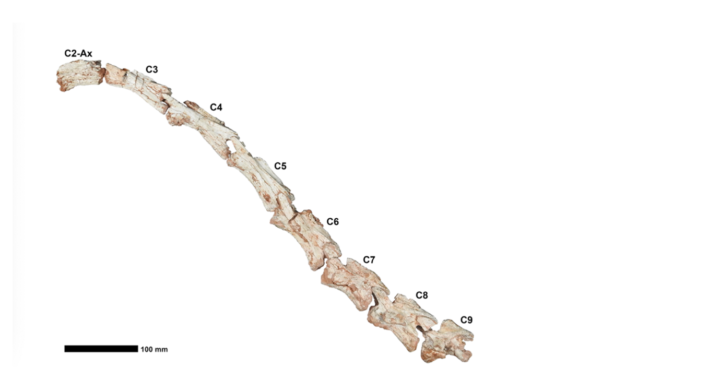
Figure 2: Cervical vertebrae (C1-C9) of Macrocollum itaquii, shown in lateral view. The figure illustrates the complete neck vertebral series, highlighting variation in vertebral shape and proportions along the cervical column.
Engineering a Long Neck
As the vertebrae progress down the neck, they become increasingly specialised. The neural arches become taller towards the rear of the neck, likely increasing the area available for muscle attachment, while muscle attachment sites themselves become more pronounced, suggesting stronger musculature capable of stabilising and moving the elongated neck.
The cervical vertebrae also show increasing structural complexity through the development of laminae (bony ridges) and fossae (depressions). These structures likely reinforced the vertebrae against mechanical stress while reducing unnecessary skeletal weight and providing attachment sites for muscles and soft tissues.
Together, these features reveal that the neck of Macrocollum was not simply longer, it was becoming mechanically more sophisticated.
Beyond the Neck
The researchers also examined the dorsal vertebrae, the bones that make up the back. At the point where the neck transitions into the torso, the vertebrae become shorter and more robust while the ribs grow substantially larger, marking the shift from a flexible neck to a stronger trunk.
Despite possessing one of the earliest elongated necks among sauropodomorphs, Macrocollum’s dorsal vertebrae remained relatively conservative. This supports the idea that neck elongation initially evolved through the stretching of cervical vertebrae rather than by converting back vertebrae into neck vertebrae, as occurred in some later species.
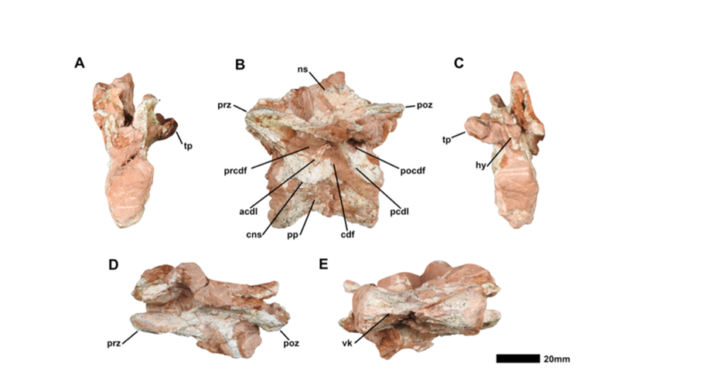
Figure 3: First dorsal vertebra of Macrocollum itaquii. This vertebra marks the boundary between the neck and torso, showing anatomical changes associated with the transition from a flexible neck to a stronger trunk.
Pneu and Improved?
Perhaps even more intriguing is the possibility that Macrocollum preserves early evidence of skeletal pneumaticity, air-filled spaces within bones. In later sauropods, many bones contained hollow chambers like those seen in modern birds. These cavities reduced skeletal weight and may have helped support their enormous necks.
The study identifies possible pneumatic structures within one of Macrocollum's cervical vertebrae. Although the interpretation remains uncertain, it raises the possibility that some lightweight skeletal features associated with later sauropods originated much earlier in sauropodomorph evolution.
Importantly, Macrocollum itself was nowhere near the size of later sauropods. If these structures genuinely represent early pneumaticity, they suggest that skeletal lightening evolved before gigantism rather than as a response to it. If correct, this would provide another example of how characteristic sauropod features emerged gradually over evolutionary time.
A Window into Sauropod Origins
Ultimately, Macrocollum itaquii provides a rare glimpse into one of the earliest stages of sauropod evolution. Long before dinosaurs such as Diplodocus and Argentinosaurus towered across prehistoric landscapes, the anatomical foundations of their success were already beginning to emerge in smaller, more primitive ancestors.
Macrocollum shows that the foundations of sauropod gigantism were assembled gradually, with innovations in neck length, vertebral architecture and skeletal lightening appearing long before giant body size itself evolved. By preserving this transitional stage, Macrocollum helps reveal how evolution assembled one of the most extraordinary body plans in Earth's history, one vertebra at a time.

Guest Blogger
Written by guest blogger Beth Taylor, a Zoology graduate from the University of Roehampton with interests in evolutionary biology, biodiversity, planetary health and environmental change. Edited by Georgia Cowie.

About the Journal
This blog was inspired by a paper published in our Zoological Journal, an international journal publishing high-quality papers covering systematic & evolutionary research from species both alive and extinct. Want to contribute to a blog? Contact the Journal Officer directly.