Island-Hopping Frogs: How Geology, Ocean Currents and Evolution Shaped Biodiversity in the Pacific
Exploring how impropable frogs dispersed and diversified across the Pacific ocean. Written by guest blogger Caroline Sgorbati.
Published on 21st April 2026
Amphibians are among the last animals one might expect to find on remote oceanic islands. Their permeable skin makes them highly sensitive to salt, and mostly rely on freshwater to reproduce. Yet across the Pacific, from Southeast Asia to Fiji, a group of frogs has achieved what seems almost impossible: colonising island chains separated by thousands of kilometres of open ocean. How did they get there, and what can their journey tell us about how biodiversity evolves on islands?
Meet the Frogs
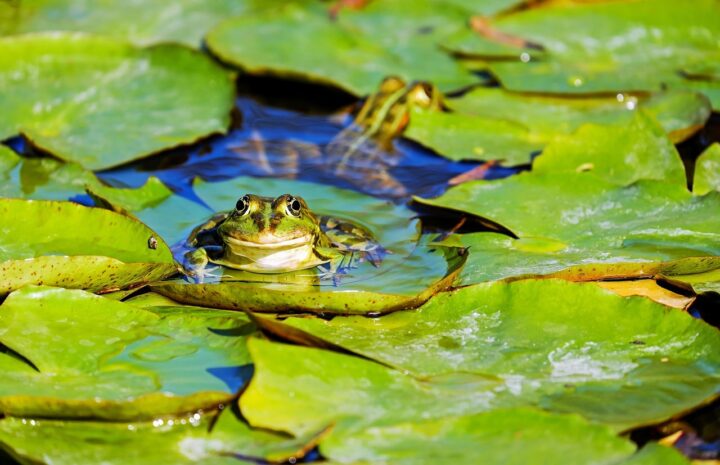
Figure 1: Frogs come in all shapes and sizes, with over 500 species.
Our frogs belong to the family Ceratobatrachidae (Figure 1), a surprisingly diverse group of 104 currently recognised species. Even more surprising is where they are found, as these frogs appear on both sides of the Wallace’s Line (as shown in Figure 2), the invisible biogeographical boundary slicing through Southeast Asia that separates the fauna of Asia from that of Australia and Oceania. For animals so closely tied to freshwater, this is an impressive accomplishment.
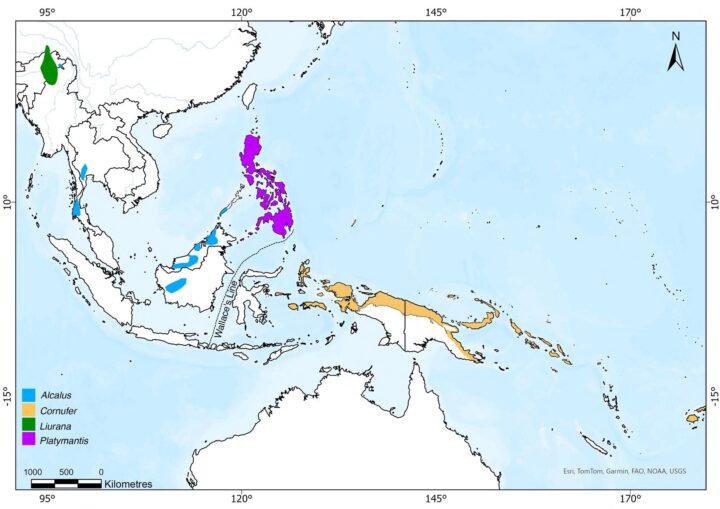
Figure 2: Global distribution of the four Ceratobatrachidae genera.
Interestingly, most species in this family can be grouped as terrestrial, semi-aquatic, arboreal or scansorial, suggesting a remarkable ability to exploit different ecological niches.
Adding another twist to the story is the frogs’ striking sexual size dimorphism (SSD), where males and females consistently differ in body size. In fact, the most extremely sexually dimorphic frog species known belongs to this very family, with females growing up to forty times heavier, and three times longer than their male counterparts. In the animal world, such differences are often linked to sexual selection, with larger females favoured for reproduction. Also, sexual selection is a powerful driver of species diversification. Could it, too, have helped shape the spread and diversity of Ceratobatrachidae across the Pacific?
Following the Evolutionary Trail
Crossing ocean barriers is usually the preserve of much smaller organisms, think snails hitching an accidental lift on birds across the sea. Frogs, on the other hand, are not exactly known for their seafaring abilities. So how did they manage it? Until now, no study had directly tested the evolutionary hypothesis that might explain this trans-marine dispersal success.
One tempting explanation is that Ceratobatrachidae represent an adaptive radiation, the process where a single ancestral species rapidly diversifies into many, each shaped by different environments. At first glance, this makes sense. Case closed? Not quite.
To untangle this evolutionary mystery, the authors of this paper—published in the Zoological Journal of the Linnean Society—took a wide-angle view, combining genetic data, geography and the geological history of the Pacific.
They built a “family tree” of these frogs using DNA from multiple genes, which allowed them to see how species are related and estimate when they first appeared. Then, they looked at traits like body size, difference between males and females, and lifestyles to map how these traits changed over time. By combining this with information on where the frogs live and how islands formed and shifted, they could explore how movement between islands and ecological changes shaped the incredible diversity we see today.
Where Did the Frogs Come From?
The study found that, across their history, Ceratobatrachidae frogs showed constant rates of evolution and retained many of their ancestral traits, with only a few changes in habitat preference, body size and SSD. Surprisingly, these findings go against the adaptive radiation hypothesis. Instead the most plausible explanation is a pattern of episodic dispersal: frogs hopped across islands when they were close together (millions of years ago!), followed by slow diversification as the islands became more isolated. In other words, these frogs are patient, slow-and-steady explorers of the Pacific.
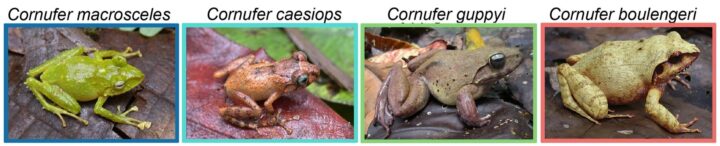
Ancestral ecotypes of Ceratobatrachidae frogs. Taken from Figure 3 of Deepak, Kraus & Maddock, 2025.
Why Is This Family So Diverse?
Take the genus Cornufer, for example. These frogs show remarkable variation in body size because some colonised large islands very early, when open space and minimal competition allowed them to grow impressively large. On the other hand, on islands where other frogs were already present, species stayed smaller, with less difference between males and females. Habitat also played a role: terrestrial frogs could become bigger and more dimorphic, while tree-dwelling species remained small and agile, perfectly adapted to life among the branches. In short, size and romance, in case of sexual dimorphism, were shaped by both lifestyle and location.
But what about crossing the ocean? Ceratobatrachidae may tolerate a little salt, but their real secret was geography. Over millions of years, chains of ancient islands stretching from the Philippines to Fiji acted as stepping stones. Frogs likely hitched rides on vegetation rafts during floods, aided by shifting currents and warmer climates. Ultimately, at the crossroads of geology and evolution these small amphibians turned into true Pacific explorers.
Hopping into the Future
To wrap things up, these frogs show that evolution doesn’t always need to be fast; sometimes slow, steady, and adventurous works just as well. By rafts, currents, and a bit of island luck, they’ve spread across the Pacific, diversified, and thrived. Ultimately, Ceratobatrachidae remind us that even tiny travellers can make epic journeys.
About the Journal
This blog was inspired by a paper published in our Zoological Journal, an international journal publishing high-quality papers covering systematic & evolutionary research from species both alive and extinct. Want to contribute to a blog? Contact the Journal Officer directly.
Guest Blogger
Written by Guest Blogger Caroline Sgorbati, a recent graduate in Global Health and Development from UCL. She is interested in the intersection of biology and population health, exploring how biological insights can inform global health challenges and promote health equity. She has a strong focus on quantitative, data-driven approaches to address multidisciplinary global health problems. Edited by Georgia Cowie.