Botanists and Blackouts: A short history of the Women’s Linnean Club
This month’s treasure takes us inside the minute book of the Women’s Linnean Club, offering a rare glimpse into a little-known chapter of the Society’s history.
Published on 15th March 2026
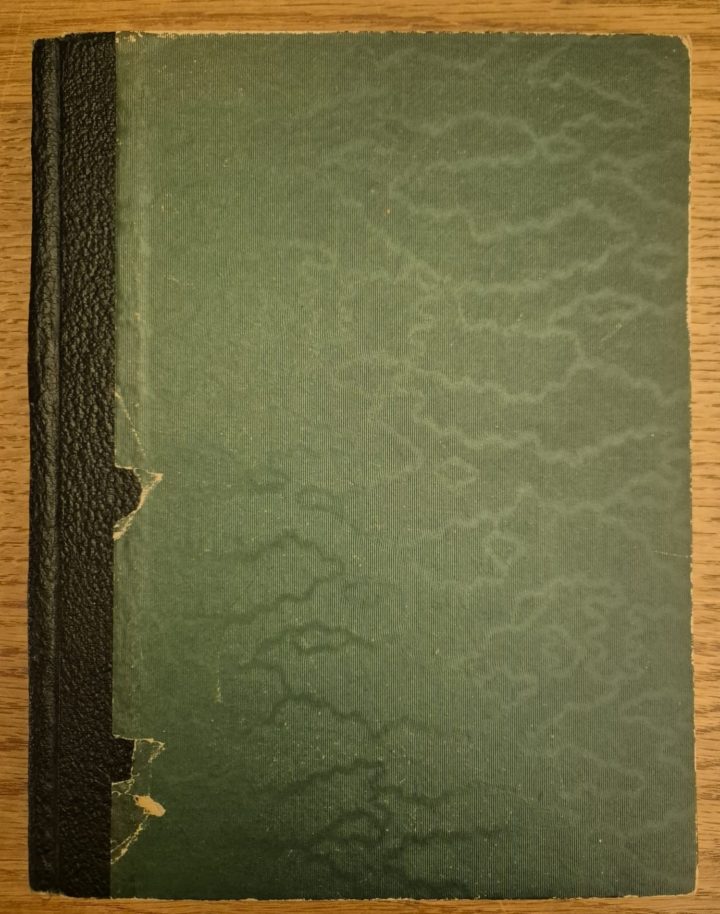
Minute Book (MS/723)
In November 1991, the Society received the minute book of the Women’s Linnean Club (MS/723). The book had been discovered by mycologists at the Royal Botanic Gardens, Kew, tucked away in a cabinet of fungal specimens that had previously belonged to Elsie Maud Wakefield (1886–1972), the club’s last secretary. Although the volume is only sparsely filled, the surviving entries offer a fascinating glimpse into a small but significant chapter of the Society’s history.
Foundation of the Club
The idea for a women’s club was first put forward in October 1938 by botanists Ellen Marion Delf (1883–1980), Mary Letitia Green (1886–1978) and bryozoologist Anna Birchall Hastings (1902–1977) – three women serving on the Linnean Society’s Council at the time. Their vision was simple: members would gather for dinner after Society meetings, with an annual subscription covering the cost of inclusion. The Club welcomed not only women Fellows but also women who had connections to the Society. Although similar in premise, it was to be distinct from the earlier-established Linnean Club (LDC), a dining club for Fellows founded in 1811.

Foundation members list

Programme for inaugural meeting
Mrs John Ramsbottom (as she is known in the minute book), wife of the then President of the Society, was invited to serve as the Club’s first President, with Anna Birchall Hastings appointed Honorary Secretary and Treasurer. There were 27 members in the Club’s foundation, including four non-Fellows. Among them were prominent individuals such as Lady Smith Woodward as well as notable figures in zoology, botany and mycology such as Anna McClean Bidder (1903–2001), Elizabeth Marianne Blackwell (1889–1973), Elsie Maud Wakefield (1886–1972) and Gulielma Lister (1860–1949). Lady Prain, wife of Sir David Prain, was elected an Honorary Member. The inaugural meeting of the club took place on 24 November 1938 at the English-Speaking Union, 37 Charles Street in London’s Berkeley Square.
Undeterred by war
Then came the Second World War. Due to the blackouts taking place in London, the Society’s meetings in 1939 and 1940 were held earlier in the day. As a result, members of the Club chose to meet for lunches at Stewart’s Restaurant on Piccadilly before the meetings, instead of dinners. During this period, male members of the original Linnean Club, which was temporarily in abeyance, were also invited to join the lunches. These arrangements continued until 1941, but with the added disruption of the air raids, there were fewer Society meetings, and only two Club lunches were held that year.

Women's Linnean Club rules
Undeterred by the war, the club carried on with its plans. The first formal business meeting was held in the Society’s rooms on the day of the Anniversary Meeting on 24 May 1941, during which the club’s constitution was officially adopted. The constitution contained 14 rules, including, ‘The number of members of women’s Linnean Club shall not exceed 30…except that 5 of them may be women connected to the Society in other ways’ and ‘Any member who has not attended the Club at least once in any year shall cease to be a member’. At this meeting, Anna Birchall Hastings resigned as Secretary upon her marriage, and Elsie Maud Wakefield stepped in temporarily to take on the role.
A final positive mark
However, by 1942, the challenges of war had made it increasingly difficult for the club to meet, with the last meeting recorded being the club’s Annual General Meeting on 13 November 1941. The final entry in the book is a small typescript memorandum, written by Elsie Maud Wakefield on 23 November 1942, explaining that, due to ongoing catering difficulties and many members living too far away, the lunches had become ‘impracticable’. She expressed the hope that Club activities could resume once conditions allowed.

Letter from E M Delf to E M Wakefield
Despite these hopes, the Club did not re-emerge. Letters written by its last remaining members, preserved in the volume, reveal that by 1955 the Women’s Linnean Club had ceased to exist. With declining interest and unsuccessful attempts to revive it, the Club, in the words of Ellen Marion Delf, became a ‘war casualty’. Though the Club itself did not survive, it left a final, positive mark by donating its unexpended funds to enrich the Society’s library.
The full catalogue record for the Women’s Linnean Club minute book can be found through our online catalogue.
Christina McCulloch, Assistant Archivist