The Politics of Taxonomy - Tangled in a Web of Inequalities
How spiders uncovered gender and geopolitical disparities in one of the world’s oldest practices. Written by guest blogger Catherine Sgorbati.
Published on 4th March 2026
Who Are the Victors?
We have all heard the famous phrase “History is written by the victors”, but have you ever wondered who the are victors in science, or if any exist at all?
Well, Montana et al. surely did. In a paper published as part of the Special Issue “Mobilizing Natural History Collections in the Global South” in the Biological Journal of the Linnean Society, they shine a light on author trends in taxonomy, revealing who had the opportunity to tell the story for a very interesting subject.
The Threads of Taxonomy
For thousands of years, humans have tried to understand the world by classifying what was around them. Through oral and written traditions, these organisms were identified and catalogued as either dangerous or beneficial to humans. As the centuries passed this practice evolved into what we know now as ‘Taxonomy’, documenting the Earth’s biodiversity. This discipline was especially shaped in the 18th century by Carl Linnaeus, often referred to as “the father of modern taxonomy”.
What started as an academic discipline among a small group of European academics may not have overcome gender and geopolitical boundaries. The question that therefore arises is: what does it take to become an author for species identification in the 21st century?
The answer, according to this paper, is clear: it requires extensive training and resources to develop the skills needed to recognise a new species. Sadly, access to these opportunities has often been limited for minorities, a pattern witnessed across multiple scientific fields, as reflected in the persistent underrepresentation of women among published authors.
To uncover these patterns the authors have decided to focus on a surprising but revealing subject: spiders.
The Un-weaving of Spiders’ History
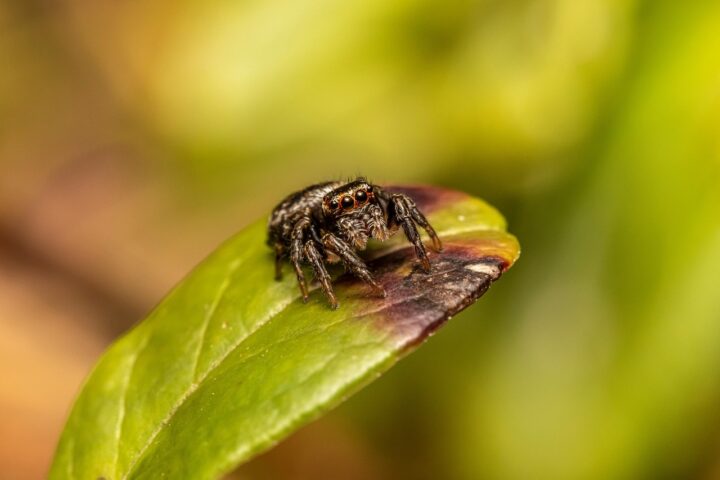
Spiders, whilst often perceived to be scary, come in all shapes and sizes. Like this little jumping spider, no bigger than the end of a pencil.
Spiders are a unique case in modern taxonomy, as they were among the first animals to receive scientific names under the binomial system, thanks to Clerck’s meticulous work in Svenska Spindlar (“Swedish Spiders”, 1757). Many of these names are still recognised today alongside those established by Linnaeus in Systema Naturae (1758), which formalised modern zoological nomenclature.
As one might easily guess, arachnology is no exception when it comes to discrimination. In fact, limited involvement of women and people of colour has been historically recorded. Furthermore, an interesting phenomenon, possibly linked to the colonial past, is observed, known as parachute science.
Parachute science is the practice of scientists from the Global North conducting research and fieldwork in the Global South, producing novel knowledge without reciprocating the same opportunities to their colleagues from the Global South, who often face barriers such as limited funding. In entomology (the study of insects), this phenomenon is demonstrated by the fact that scientists from the Global North publish 60% more than those in southern regions.
A Story Told by Too Few
Addressing these inequalities is vital to ensure that knowledge doesn’t get lost due to the location or identity of the authors, creating a fairer world for everyone. Montana et al. attempt to do just that, uncovering patterns of under-representation of women and researchers from the Global South by investigating the composition of authors over time within spider taxonomy.
Spinning the Web: Uncovering the Patterns
Using data from the World Spider Catalog (WSC), Montana et al. gathered information on every spider described from the Americas between 1946 and 2021, analysing over 9,000 species and nearly 600 researchers. Each author’s gender and the location of their institution were recorded, with countries grouped into the Global North or Global South according to UN definitions. Statistical analyses then revealed how gender and geography intersected over time, showing how the narrative of discovery has been shaped, and by whom.
The results tell a disheartening yet predictable story: male authors composed the majority of the storytellers, nearly three quarters of all taxonomists, while women represented only a quarter of authors overall (Figure 2).
Similarly, researchers from the Global North have often been the ones holding the pen, even when writing about species found in the Global South, a pattern echoing the parachute science previously mentioned.
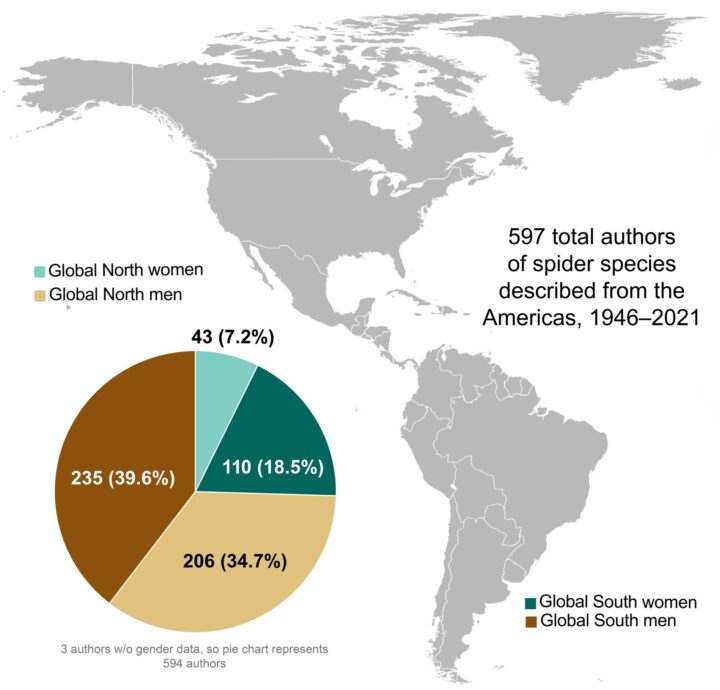
Figure 2 - Proportion of authors by gender and geopolitical affiliation among 594 spider taxonomists. Men from the Global South form the largest group (39.6%), followed by men from the Global North (34.7%). Women remain underrepresented, with 18.5% from the Global South and 7.2% from the Global North.
Who Spins the Next Chapter
Despite these results, a new chapter is beginning to form. Since the early 2000s, collaborations across both gender and geography have grown, with more women working alongside scientists from the Global South. As one underrepresented group gains its voice, others follow, showing that diversity fosters more diversity. But the balance is far from equal. Women rarely lead authorship, and Global South researchers remain underrepresented despite living closest to much of the world’s biodiversity.
This shift shines a light on this unfinished narrative. Women have persisted as storytellers since 1946 (Figure 3), often despite systemic barriers, social conservatism, and the invisible labour that sustains academia, what they call the “academic housework” of science.
Pioneers such as Elizabeth Bangs Bryant, Harriet Exline Frizzell, and María Elena Galiano wrote their own remarkable chapters, however, their stories also reflect the limits still faced today. The rise in mixed-gender and international collaborations after the year 2000 reflects decades of activism, education, and policy change, but as the paper concludes, collaboration alone does not rewrite the plot. True equity in taxonomy, and in science itself, will only come when everyone is free to tell the story of the natural world regardless of identity or place of birth.
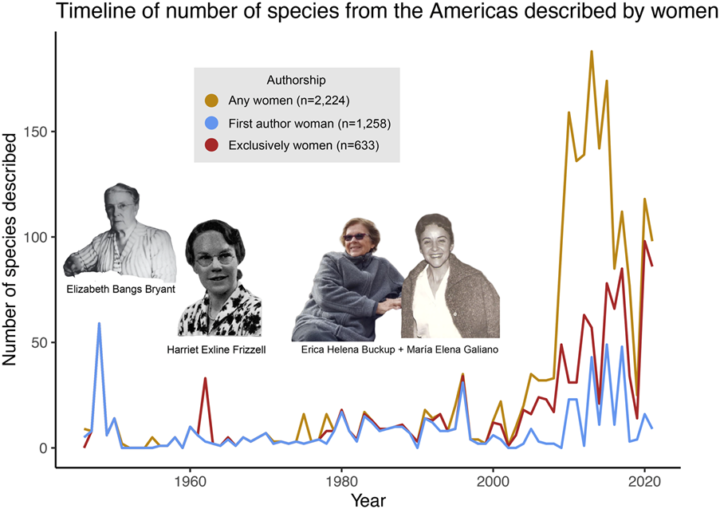
Figure 3 - Timeline of women’s authorship in spider taxonomy from 1946 to 2021. Each line shows teams with any women, a woman first author, or all-women authors, highlighting both persistence and slow progress toward equality.
Still Untangling the Web
This study symbolises a step towards a world where careers in taxonomy are attainable to any passionate storyteller. As the story becomes more accessible, taxonomy can move toward a future where the naming of life reflects all those who seek to understand it, and where every voice can add its own thread to the web of discovery.
About the Journal
This blog was inspired by a paper published in our Biological Journal, the direct descendant of the oldest biological journal in the world. It publishes ground-breaking research specialising in evolution in the broadest sense, and especially encourages submissions on the impact of contemporary climate change on biodiversity. The Special Collection Mobilizing Natural History Collections in the Global South of which this paper is a part of, seeks to promote and encourage the publication of integrative research from NHCs in the Global South, emphasizing their crucial role in advancing biodiversity science and expertise. Want to contribute to a blog? Contact the Journal Officer directly.
Guest Blogger
Catherine Sgorbati (she/her) is a recent graduate in Artificial Intelligence in the Biosciences from Queen Mary University of London now working as a Language Specialist for Qualitest. She is interested in exploring how data and technology can deepen our understanding of living systems: from ecosystems and field ecology to human physiology and health. Her passion spans all areas of biology, and she enjoys connecting computational methods with real-world biological questions. Edited by Georgia Cowie, Journal Officer at the Linnean Society.